
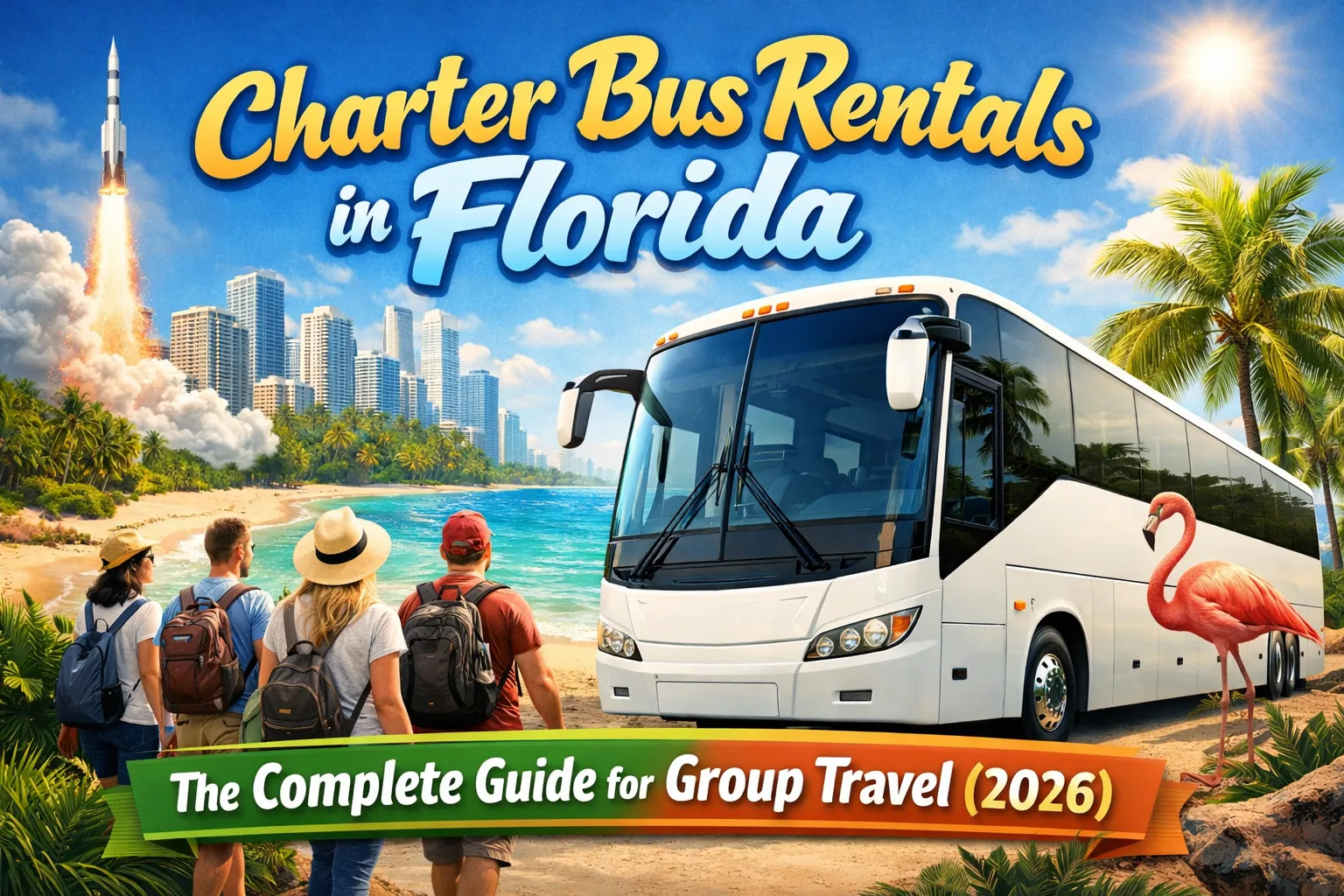
Planning a group trip in Florida sounds exciting. But getting everyone from point A to point B? That part gets complicated fast. Florida is a massive state. It stretches over 65,000 square miles with dozens of major cities, theme parks, cruise ports, and coastal towns spread across it. Driving separately means lost people, late arrivals, and a lot of unnecessary stress.
That is where charter bus rentals come in. A charter bus keeps your entire group moving together, on schedule, and without the chaos. Whether you are organizing a school field trip to Orlando, a corporate retreat in Tampa, or a wedding group transfer in Miami, Florida’s charter bus industry has options built for every need and every budget. This guide breaks it all down for you, from bus types and pricing to safety standards and how to pick the right company.
What Is a Charter Bus and Why Is It Popular in Florida?
Have you ever wondered why so many Florida travel planners skip rental cars and go straight to charter buses?
A charter bus is a privately hired motor coach. You book the entire vehicle for your group. No shared passengers. No random stops. No fixed route. The bus goes where you need it to go, on your schedule. It is different from a public transit bus or a scheduled Greyhound service. With a charter bus, the vehicle and driver are exclusively yours for the duration of the trip.

Florida is one of the busiest group travel states in the entire United States. It welcomes over 130 million tourists every single year. Cities like Orlando, Miami, and Tampa see millions of group travelers, school students, corporate teams, wedding parties, sports fans, and cruise passengers, all needing organized, reliable transportation. That volume is exactly why the charter bus industry is so deeply rooted here.
The state also has a geography that makes charter buses a practical choice. Florida has no mountains or complex terrain. Its highway system, including I-4, I-75, I-95, and the Florida Turnpike, connects almost every major destination smoothly. A charter bus can move a group of 50 people from Orlando to Miami in about four hours with zero parking headaches on either end.
Beyond convenience, Florida’s heat plays a role too. Summer temperatures regularly hit 95°F with heavy humidity. Waiting in parking lots, switching between multiple vehicles, or standing at bus stops becomes genuinely uncomfortable. A climate-controlled motor coach with reclining seats changes the entire travel experience from exhausting to relaxed.
Top Reasons to Choose a Charter Bus in Florida
Most people assume charter buses are only for large school trips or corporate events. That assumption is wrong.
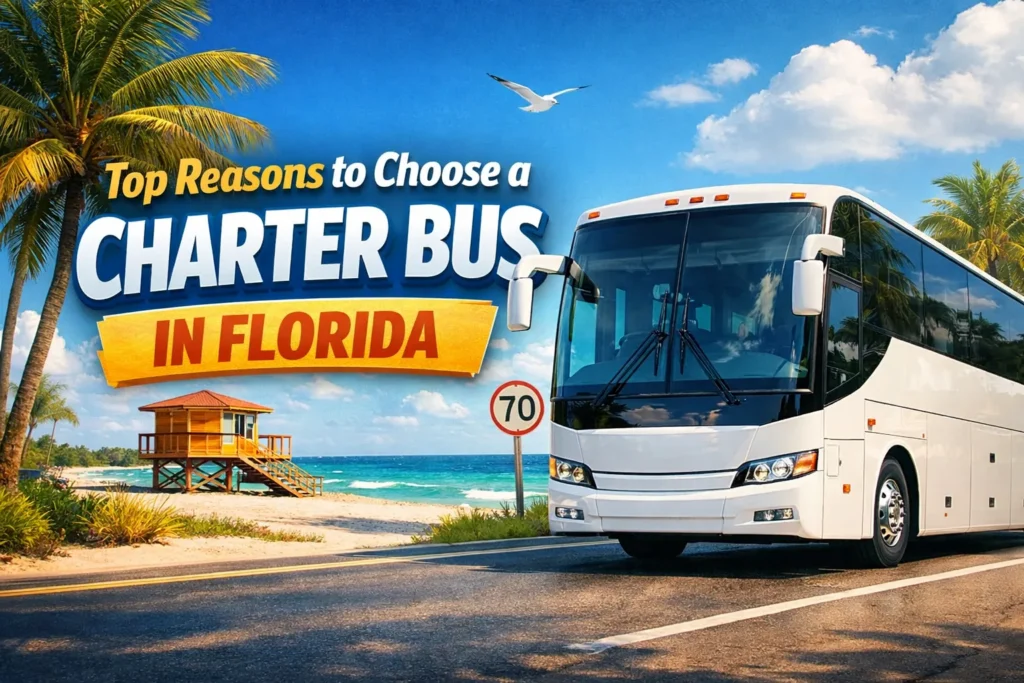
Charter buses in Florida are used by families, wedding planners, sports coaches, tour operators, and everyday travelers. The reasons people choose them go far beyond just “we have a big group.” Let’s break down the real benefits that make charter buses a genuinely smart decision for Florida group travel.
Everyone Stays Together
Have you ever arrived at a destination and spent the first 30 minutes waiting for half your group to show up?
That problem disappears with a charter bus. Every single person boards at the same location and arrives at the same time. There is no splitting into separate cars. No one gets lost on an unfamiliar Florida highway. No miscommunication about which parking lot to meet at. For large groups especially — school trips, family reunions, corporate teams, this alone is worth the cost. Group cohesion matters. When everyone arrives together, the event starts on time and the energy stays high.
Stress-Free Travel
Florida roads are not always easy. Interstate 4 in Orlando is consistently ranked among the most dangerous highways in the United States. Miami traffic is notoriously heavy, especially during peak tourist season between December and April. Driving through these conditions while also managing navigation, passengers, and timing is genuinely stressful.
A charter bus removes all of that from your plate. A licensed, experienced driver handles everything behind the wheel. You sit back, talk to your group, review your itinerary, or simply rest. The mental load of driving disappears entirely. This matters especially for trip organizers who already have a hundred other things to manage on the day of travel.
Cost-Effective Group Transportation
Does renting multiple vehicles actually save money compared to a charter bus? In most cases, no.
When you break down the real numbers, charter buses make strong financial sense for groups. Consider a group of 45 people traveling from Orlando to Miami. If they split into rental cars, that is roughly nine vehicles. Each car costs around $60 to $80 per day in Florida. Add fuel, which averages $3.20 per gallon across the state, plus parking fees at Miami venues that can hit $40 to $60 per vehicle. The total climbs fast. A charter bus for the same trip can cost between $900 and $1,500 total. Split across 45 people, that is roughly $20 to $33 per person. The charter bus almost always wins on price for groups of 20 or more.
Safe for Students, Families and Elderly
Is safety actually better on a charter bus than in a private vehicle? The data says yes.
The Federal Motor Carrier Safety Administration (FMCSA) reports that motorcoaches are one of the safest forms of ground transportation in the United States. Charter buses undergo regular federal safety inspections. Drivers must hold a Commercial Driver’s License (CDL) with a passenger endorsement. They are subject to hours-of-service regulations to prevent fatigue. For school groups, elderly passengers, and families with young children, this level of regulated safety provides real peace of mind that a rental car simply cannot match.
Eco-Friendly Travel Option
Florida is home to sensitive ecosystems. The Everglades, Biscayne Bay, and Florida’s extensive coastline all face environmental pressure from tourism and traffic. A full-size charter bus carrying 50 passengers produces significantly fewer carbon emissions per person than 50 people driving individually. Studies from the American Bus Association show that motorcoaches are the most fuel-efficient form of ground transportation per passenger mile. Choosing a charter bus is a small but meaningful step toward reducing your group’s environmental footprint in a state where that footprint genuinely matters.
Comfortable for Long Distances
Florida is long. The drive from Pensacola in the northwest to Key West in the south covers nearly 800 miles. Even popular routes like Tampa to Miami run about 280 miles. Sitting in a standard car seat for that duration is tiring.
Modern charter buses are built differently. Passengers get wide reclining seats, generous legroom, overhead storage, and climate control set to a comfortable temperature regardless of Florida’s outdoor heat. Many coaches include onboard restrooms, USB charging ports, and entertainment screens. Long-distance travel stops feeling like an endurance test and starts feeling like a comfortable, productive part of the trip itself.
Types of Charter Buses Available in Florida
Not every group has the same size, budget, or travel style. So why would every group need the same bus?
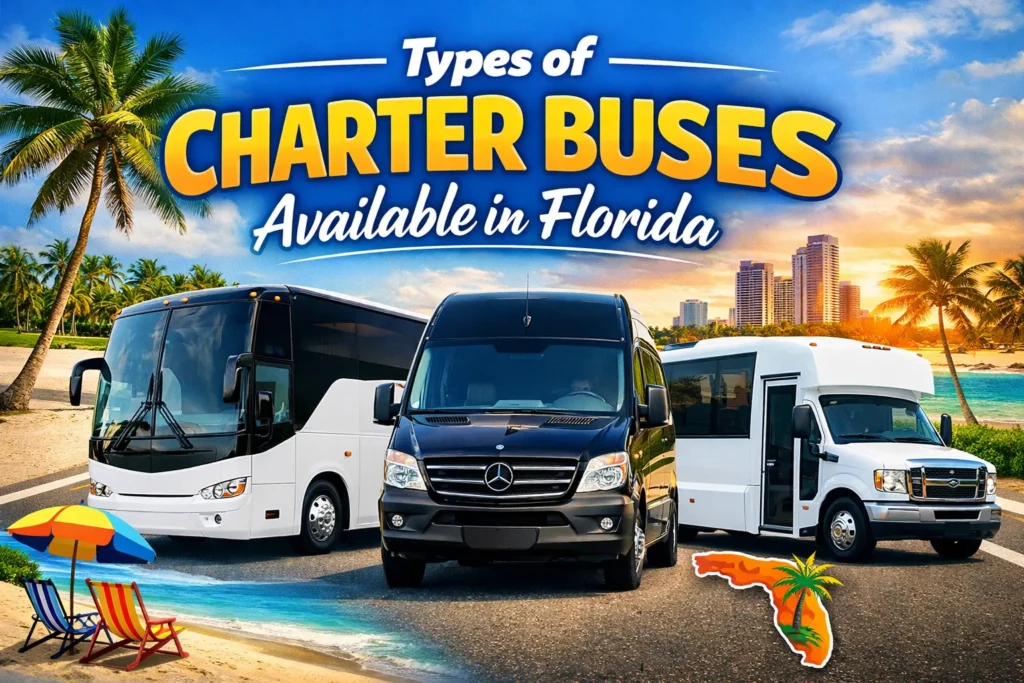
Florida charter bus companies offer a range of vehicle types. Choosing the right one matters more than most people realize. The wrong bus size can mean paying for empty seats or cramming passengers uncomfortably. Understanding what each vehicle offers helps you make a smarter booking decision from the start.
Full-Size Motor Coach (50–56 Passengers)
Have you ever seen a large luxury coach pulling into a theme park or cruise terminal in Florida? That is almost always a full-size motor coach.
This is the most commonly rented charter bus in Florida. It seats between 50 and 56 passengers and is designed for long-distance, high-comfort travel. Full-size motor coaches are the workhorses of Florida group transportation. They are the vehicle of choice for corporate retreats traveling from Jacksonville to Orlando, school groups heading to Kennedy Space Center, and large wedding parties moving between venues across Miami-Dade County.
These coaches typically come equipped with reclining seats, overhead luggage compartments, onboard restrooms, air conditioning, Wi-Fi, and power outlets. The undercarriage storage is spacious enough to handle luggage, sports equipment, or event supplies for the entire group. If your group is 35 people or more and traveling more than 50 miles, a full-size motor coach is almost always the most practical and cost-efficient option.
Minibus (18–35 Passengers)
What happens when your group is too big for a van but too small to justify a full-size coach?
That is exactly the gap a minibus fills. Minibuses in Florida typically seat between 18 and 35 passengers. They are smaller and more maneuverable than a full-size coach, which makes them ideal for navigating tighter urban environments like downtown Miami, Ybor City in Tampa, or the narrow streets near St. Augustine’s historic district.
Minibuses are a popular choice for corporate airport transfers, small wedding shuttle services, private sightseeing tours, and medium-sized school groups. They offer most of the same comfort features as a full-size coach, climate control, comfortable seating, and storage, just scaled down for a smaller group. For groups between 20 and 35 people, a minibus is often the smartest balance between comfort and cost.
Shuttle Bus
Are you moving a group between two fixed points repeatedly throughout a single day?
A shuttle bus is built for exactly that purpose. Shuttle buses in Florida are commonly used for hotel-to-venue transfers, airport pickup and drop-off services, theme park parking lot transfers, and corporate campus employee movement. They typically seat between 24 and 40 passengers depending on the configuration.
Shuttle buses are designed for shorter, repetitive routes rather than long cross-state journeys. Many Florida event venues, including convention centers in Orlando and Miami Beach, rely heavily on shuttle bus fleets to move attendees efficiently between parking areas and event entrances. If your event involves continuous passenger movement throughout the day rather than a single long-distance trip, a shuttle bus is likely your best operational choice.
Sprinter Van
Does your group have fewer than 15 people but still needs a professional, organized transportation solution?
A Sprinter van bridges the gap between a standard rental vehicle and a full minibus. These vans typically seat between 10 and 14 passengers. They are sleek, modern, and considerably easier to park than a full bus, a genuine advantage in busy Florida cities where parking is limited and expensive.
Sprinter vans are a favorite for executive airport transfers in Miami, small VIP corporate groups, intimate wedding party transportation, and private guided tours through areas like the Florida Keys where road width and parking availability are genuinely limited. They offer a premium feel without the scale of a full charter bus. Many come equipped with leather seating, USB charging ports, and climate control.
Party Bus
What if the journey itself is supposed to be part of the celebration?
A party bus turns transportation into an experience. Party buses in Florida are most commonly rented for bachelorette parties, birthday celebrations, prom nights, graduation events, and nightlife tours across cities like Miami, Tampa, and Orlando. They typically seat between 20 and 40 passengers depending on the layout.
Inside, a party bus looks nothing like a standard motor coach. Expect wraparound leather seating, LED mood lighting, built-in sound systems, dance floors, flat-screen televisions, and sometimes even a small bar area. Florida’s vibrant nightlife scene, particularly in Miami’s South Beach and Orlando’s entertainment district, makes party buses an extremely popular rental category throughout the year.
School Bus
Is a school bus only for school trips? Not exactly.
Traditional yellow school buses remain a practical and budget-friendly option for certain types of group travel in Florida. They seat between 48 and 72 passengers and are among the most affordable charter options available. Beyond student field trips, school buses are regularly rented for community organization events, church group outings, nonprofit transport, and low-budget sports team travel.
They are not the most comfortable option for adults on long distances, seating is basic and amenities are minimal. But for short to medium distance trips where budget is the primary concern, a school bus gets the job done reliably. Florida charter companies that operate school buses must comply with strict Florida Department of Education and FMCSA safety regulations regardless of whether the passengers are students or adults.
Amenities & Features You Can Expect Onboard
Most people think of a charter bus as just a big vehicle that moves a group from one place to another. The reality is much more comfortable than that.

Modern charter buses in Florida are equipped with features that make long journeys genuinely enjoyable. Understanding what amenities are standard and what requires an upgrade helps you set the right expectations before you book. It also helps you communicate clearly with the charter company about what your group actually needs.
Seating & Comfort
Have you ever spent four hours in an uncomfortable seat and arrived at your destination already exhausted before the event even started?
Seating quality on a charter bus is significantly better than most people expect. Full-size motor coaches come with high-back, cushioned reclining seats. Each seat typically offers between 36 and 40 inches of pitch, that is the distance between your seat and the one in front of you. For reference, most economy airline seats offer around 30 to 31 inches. You genuinely have more legroom on a quality motor coach than on a domestic flight.
Seats are arranged in a standard two-by-two configuration on most coaches. Armrests are adjustable. Headrests are padded. On premium coaches operating Florida routes, you may find seats with built-in footrests and extra lumbar support. For elderly passengers or anyone with back concerns, this level of seating comfort is a meaningful factor when choosing charter transportation over other options.
Wi-Fi and Power Outlets
Is staying connected during a long Florida drive actually possible on a charter bus?
Yes, and it has become a standard expectation rather than a luxury feature. Most modern charter buses operating in Florida come equipped with onboard Wi-Fi. The connection is provided through cellular network aggregation, pulling signal from multiple carriers simultaneously to maintain a more stable connection even on rural stretches of highway like US-27 through central Florida or SR-80 near Lake Okeechobee.
Power outlets and USB charging ports are typically available at every seat or every two seats depending on the coach configuration. For corporate groups who need to work during transit, school groups with devices, or tourists who want to stay connected, this feature alone adds real practical value to the journey. Always confirm Wi-Fi availability when requesting your quote, as older coaches in some fleets may not have it installed.
Climate Control & Entertainment Systems
Florida’s heat is not a minor inconvenience. In July and August, outdoor temperatures in cities like Orlando and Miami regularly exceed 95°F with humidity levels above 80 percent. Stepping onto a climate-controlled charter bus after standing in that heat is an immediate relief.
Charter buses use independent climate control systems that maintain a consistent interior temperature regardless of outdoor conditions. The system can be adjusted by the driver based on passenger comfort. On longer Florida routes, this is not a luxury, it is a necessity.
Entertainment systems on modern coaches typically include flat-screen monitors mounted throughout the cabin. These screens can display movies, presentations, event schedules, or live sports. For school groups, teachers sometimes use the screen to brief students before arriving at destinations like the Florida Museum of Natural History or the Kennedy Space Center Visitor Complex. For corporate groups, it serves as a mobile presentation space. Premium coaches may also include surround sound systems and Bluetooth audio connectivity.
Onboard Restrooms
Does a charter bus really have a restroom? And is it actually usable?
Most full-size motor coaches operating in Florida do include an onboard restroom located at the rear of the vehicle. It is compact but functional. It contains a toilet, a small sink, and basic supplies. It is not comparable to a hotel bathroom, but for a group traveling four or more hours from, say, Jacksonville to the Florida Keys, having onboard restroom access eliminates the need for unnecessary rest stops that break trip momentum.
For shorter routes under two hours, many operators use coaches without restrooms as these vehicles are typically newer or differently configured. Always confirm restroom availability when booking if your trip covers a significant distance. Groups traveling with elderly passengers or young children especially benefit from confirming this feature in advance.
Storage Space
What do you do with luggage, sports equipment, costumes, or catering supplies when your entire group is traveling together?
Charter buses are built with serious storage in mind. Full-size motor coaches have large undercarriage luggage bays running along both sides of the vehicle. These bays can hold full-size suitcases, duffel bags, instrument cases, sports gear, and event equipment. The total storage capacity on a standard motorcoach undercarriage is typically between 300 and 400 cubic feet — enough for every passenger to bring substantial luggage without any compromise.
Inside the cabin, overhead storage bins run the length of the bus similar to an airplane. These are ideal for smaller bags, backpacks, jackets, and personal items passengers want to access during the journey. For Florida groups traveling to multi-day events, sports tournaments, or extended corporate retreats, this level of storage capacity is a practical necessity that smaller vehicles simply cannot match.
Are Charter Buses Wheelchair Accessible?
This is one of the most important questions a trip organizer can ask, and it is one that does not always get asked early enough.
Not all charter buses in Florida are ADA compliant. The Americans with Disabilities Act requires wheelchair accessibility on certain categories of public transportation, but private charter buses operate under different regulations. Some charter companies in Florida do maintain ADA-accessible coaches equipped with wheelchair lifts, securement systems, and priority seating near the entrance. However, these vehicles are a smaller portion of most fleets and need to be specifically requested.
If your group includes passengers who use wheelchairs, mobility scooters, or other assistive devices, communicate this clearly and early when contacting charter companies. Ask specifically whether their ADA-compliant vehicles are available on your travel date. Do not assume accessibility is a default feature. Confirming this detail upfront prevents serious problems on the day of travel.
Can You Bring Food, Drinks and Alcohol Onboard?
What are the actual rules about food and drinks on a Florida charter bus? The answer depends on the company and the type of trip.
Most charter bus companies in Florida permit passengers to bring light snacks and non-alcoholic drinks onboard. This is especially common on longer routes where stopping for meals would significantly extend travel time. Bringing your own refreshments keeps the group comfortable and the schedule intact.
Alcohol policies vary significantly between operators. Many companies allow alcohol on adult trips, bachelorette parties, corporate events, and nightlife tours, with the condition that passengers are of legal drinking age and that the group is responsible for cleanup. Some operators require a cleaning deposit when alcohol is permitted. Others prohibit it entirely, particularly on school and family trips.
Hot food with strong odors is generally discouraged on most coaches. The enclosed cabin space means smells linger and can make the journey unpleasant for other passengers. Confirm the specific food and beverage policy with your charter company at the time of booking. Get it in writing in your contract so there is no confusion on travel day.
Frequently Asked Questions About Charter Bus Rentals in Florida
People research charter buses carefully before booking. These are the questions that come up most often, answered clearly and honestly.
Can I Rent a Charter Bus Without a Driver?
This is a common question, especially from people who already have someone in their group with a Commercial Driver’s License.
In Florida, almost all charter bus rental companies require their own licensed driver to operate the vehicle. You cannot simply rent the bus and drive it yourself, even if you hold a CDL. The reason is straightforward. Charter companies carry specific commercial insurance policies that are tied to their own vetted, trained drivers. Allowing an outside driver voids that coverage entirely. Additionally, Florida state law and FMCSA regulations hold the operating company responsible for driver qualifications and hours-of-service compliance. If you find a company offering driverless charter bus rentals, treat that as a significant red flag about their legitimacy and insurance standing.
How Far in Advance Should I Book My Charter Bus in Florida?
Does booking earlier actually make a difference, or is it just standard advice that companies give to lock in revenue?
It genuinely makes a difference in Florida specifically. Florida is one of the highest-demand charter bus markets in the entire country. Peak seasons include spring break in March, summer tourism between June and August, the holiday travel period from Thanksgiving through New Year, and major event weekends tied to Orlando theme parks, Miami music festivals, and Tampa Bay sports seasons. During these periods, charter bus availability tightens dramatically. Booking four to eight weeks in advance is a reasonable minimum for most trips. For large groups, major events, or peak season travel, booking three to six months ahead is strongly recommended. Last-minute bookings are sometimes possible but typically come with limited vehicle choices and higher pricing.
Can I Bring Pets on a Charter Bus?
Most standard charter bus companies in Florida do not permit pets onboard. This applies to dogs, cats, and other animals regardless of size. The primary reasons are passenger allergies, cleanliness standards, and the stress that unfamiliar enclosed environments cause most animals during long journeys.
Service animals are a different matter entirely. Under the Americans with Disabilities Act, trained service animals must be permitted on charter buses. Emotional support animals, however, do not carry the same legal protections in this context and are subject to the individual company’s policy. If you or someone in your group travels with a service animal, notify the charter company at the time of booking and confirm their specific process for accommodating the animal comfortably and safely.
Are There Restricted Items You Cannot Bring Onboard?
What exactly cannot come onto a Florida charter bus? The list is more specific than most people expect.
Firearms and weapons are prohibited on charter buses in Florida regardless of whether the passenger holds a concealed carry permit. Flammable materials, explosive substances, and hazardous chemicals are strictly forbidden under both company policy and federal transportation regulations. Illegal substances are obviously prohibited. Large coolers and oversized items that cannot fit in overhead bins or undercarriage storage may also be restricted depending on the operator.
Some companies have specific rules around large speakers, musical instruments, or photography equipment. If your group is traveling with unusual or oversized items — sports equipment, musical gear, photography rigs, or event décor — communicate this clearly when requesting your quote. Most companies can accommodate these items with advance notice, but assumptions made on travel day can create real problems at the boarding location.
Do Charter Buses Have Wi-Fi?
Most modern charter buses operating in Florida do include onboard Wi-Fi. However, the quality and reliability of that connection varies between companies and even between individual vehicles within the same fleet.
Wi-Fi on charter buses is delivered through cellular network aggregation technology. In densely connected areas like the Interstate 95 corridor between Miami and Jacksonville or the I-4 corridor between Tampa and Orlando, the connection is generally reliable. On more rural Florida routes — SR-80 through the Glades region, US-98 along the Panhandle, or stretches of US-27 through Highlands County — signal quality can drop. If consistent internet access is critical for your group, ask the charter company specifically which cellular carriers their Wi-Fi system uses and whether their coaches have been recently updated. Do not assume all buses in a fleet carry identical technology.
What Do Onboard Restrooms Look Like?
People often imagine the worst when they hear “bus restroom.” The reality on a modern Florida motor coach is more acceptable than that expectation.
Onboard restrooms on full-size charter buses are compact but clean when properly maintained. They contain a toilet, a small handwashing basin, a mirror, and basic supplies. Ventilation systems keep odors contained. The space is tight — roughly the size of an airplane lavatory — but fully functional for brief use during a long journey. Cleanliness depends heavily on how recently the vehicle was serviced and how diligently the charter company maintains their fleet. When evaluating companies, ask specifically about their vehicle cleaning and restroom maintenance schedule. A reputable company will answer that question without hesitation.
Are Charter Buses Wheelchair Accessible?
Not automatically, and this distinction matters enormously for trip organizers.
ADA-compliant charter buses in Florida are available but must be specifically requested. These vehicles are equipped with hydraulic wheelchair lifts, floor-level securement systems that lock wheelchairs safely in place during transit, and priority seating near the vehicle entrance. The number of ADA-compliant coaches in any given fleet is typically limited. If your group includes passengers who use wheelchairs or other mobility devices, request an accessible vehicle at the very first point of contact with the charter company. Waiting until closer to the travel date risks that vehicle being unavailable. Confirm the accessibility features in your written contract, not just verbally.
How Much Should I Expect to Pay for a Charter Bus in Florida?
Is there a simple answer to charter bus pricing? Honestly, no — but the key variables are well understood.
Charter bus costs in Florida are calculated primarily on a per-hour or per-mile basis depending on the operator. Full-size motor coaches typically range from $130 to $200 per hour. Minibuses run between $85 and $150 per hour. Sprinter vans generally fall between $65 and $110 per hour. These are base rates. Fuel surcharges, driver gratuity, overnight fees for multi-day trips, and cleaning deposits can add to the final invoice. For a full-day trip covering significant Florida distance — Tampa to Miami for example — expect a total cost between $1,200 and $2,500 depending on bus type and company. Always request an itemized quote so you understand exactly what you are paying for before signing any agreement.
What Happens If the Bus Breaks Down During the Trip?
This question does not get asked nearly enough during the booking process.
Reputable Florida charter bus companies maintain contingency protocols for mechanical failures. These typically include roadside assistance response teams, backup vehicle arrangements for extended delays, and 24/7 dispatcher contact. Ask any company you are considering what their specific breakdown procedure looks like. How quickly can they get a replacement vehicle? Who do passengers contact if the driver is incapacitated? What compensation or rebooking policy applies if a breakdown causes significant trip disruption? A company that answers these questions clearly and confidently is demonstrating operational maturity. A company that seems unprepared for the question is telling you something important about how they manage real problems.
Final Thoughts on Charter Bus Rentals in Florida
Florida group travel does not have to be stressful, expensive, or disorganized. A few years ago, a friend of mine tried to coordinate a family reunion of 38 people across Orlando using a mix of rental cars and rideshares. By the time everyone arrived at the venue, it was 45 minutes late, two families had taken wrong turns, and the energy of the whole group was already drained before the event even started. The following year, they booked a single charter bus. Everyone boarded together, arrived together, and the reunion started exactly on time with the entire group in high spirits.
That one decision changed the entire experience. Charter buses in Florida are not just a transportation choice, they are a group experience decision. Choose the right company, book early, ask the right questions, and your group will arrive at every Florida destination relaxed, on schedule, and ready to enjoy every moment.
Want to check Moi Qatar Visa Online?